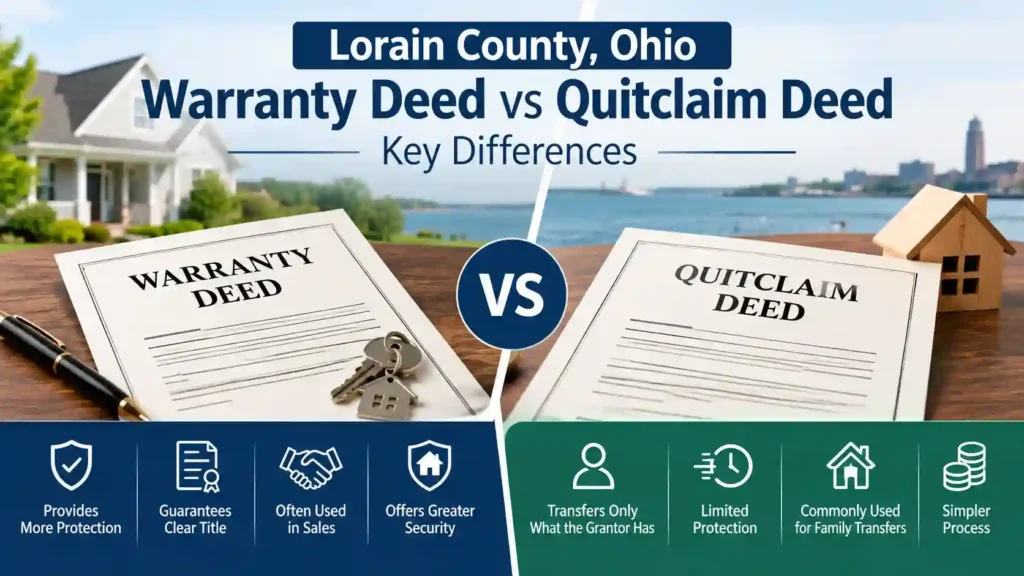
When you transfer property in Lorain County, Ohio, one of the most important decisions is choosing the right type of deed. A warranty deed provides stronger protections for the buyer by guaranteeing that the grantor owns the property free of any liens or claims.
A quitclaim deed transfers only the grantor’s interest in the property without any guarantees about ownership or title quality. Understanding these differences helps you protect your investment and complete the transfer correctly. For more property details, visit our Lorain County Auditor homepage.
How Do Warranty Deeds and Quitclaim Deeds Work?
In Lorain County, Ohio, both warranty deeds and quitclaim deeds transfer property interests, but they differ in the protection they provide. A warranty deed includes title warranties, while a quitclaim deed transfers whatever interest the grantor holds without title guarantees. Understanding how each deed works, its requirements, and its limitations can help you identify the appropriate option for your property transfer.
What Is a Warranty Deed?
A warranty deed is a legal document that transfers property while guaranteeing the grantor owns it free and clear. The grantor promises that they have full authority to transfer the property and that no other person or entity has a claim to it. If someone later challenges the title, the grantor must defend the buyer’s ownership and compensate them for losses.
This type of deed provides the highest level of protection because the grantor stands behind the title. If a hidden lien or claim emerges after the transfer, the buyer can sue the grantor to recover damages.
Types of Warranty Deeds in Ohio
- General Warranty Deed: The grantor warrants the title against defects from any time in the property’s history, even before they owned it. This offers the broadest protection to the buyer.
- Limited Warranty Deed: The grantor warrants the title only for defects that occurred during their ownership period. Defects from earlier owners are not covered.
Requirements for a Warranty Deed
- Grantor and grantee information: Full legal names and addresses of the person transferring (grantor) and receiving (grantee) the property.
- Property’s legal description: The exact parcel number, lot and block information, or metes and bounds description from the Lorain County property records.
To verify ownership and property details, see How to Get a Copy of Deed, Mortgage, Lien, Plat, or Survey in Lorain County. - Prior instrument reference and relevant transfer details: Reference to the deed or document that gave the grantor ownership, plus any relevant transfer information.
- Required signatures and acknowledgment: Grantor must sign the deed in front of a notary public who acknowledges the signature.
- Applicable conveyance forms and recording requirements: Ohio requires specific forms and the Lorain County Auditor’s conveyance or exemption form must be completed.
What Is a Quitclaim Deed?
A quitclaim deed transfers only the grantor’s interest in the property without making any promises about ownership. The grantor simply says “whatever interest I have in this property, I transfer to you” with no guarantees that they actually own it, that it is free of liens, or that their interest is valid.
If the grantor has no interest in the property, the quitclaim deed transfers nothing. If a lien or claim exists, the grantee takes the property subject to that obligation. The grantor provides no protection if problems with the title surface later.
Are There Different Types of Quitclaim Deeds?
Ohio recognizes one statutory quitclaim deed form set out in the Ohio Revised Code. While quitclaim deeds are commonly used for family transfers and divorce-related transfers, these common uses do not create separate legal deed types. A quitclaim deed used in a divorce transfer works the same way as one used between unrelated parties.
What distinguishes quitclaim deeds from warranty deeds is the complete absence of title warranties. The deed form itself does not change based on how the parties are related or why the transfer occurs. The lack of warranties remains constant across all quitclaim deed uses.
Requirements for a Quitclaim Deed
- Grantor and grantee information: Full legal names and addresses of the grantor and grantee.
- Property’s legal description: The complete legal description from Lorain County records, including parcel number or metes and bounds description.
- Prior instrument reference and relevant transfer details: Information about how the grantor acquired the property and any relevant circumstances of the transfer.
- Required signatures and acknowledgment: Grantor’s signature notarized in the same way as a warranty deed.
- Applicable conveyance forms and recording requirements: The Lorain County Auditor’s conveyance or exemption form and all applicable recording fees must be submitted.
Warranty Deed vs Quitclaim Deed: Key Differences
The main differences between these deeds come down to the level of protection, the type of interest transferred, and the legal recourse available to the buyer if problems arise.
| Aspect | Warranty Deed | Quitclaim Deed |
|---|---|---|
| Title Warranties | Grantor guarantees ownership and promises to defend the title | No warranties, no promises about ownership or title quality |
| Protection Against Title Defects | Buyer is protected, grantor is liable for hidden defects | Buyer assumes all risk, no recourse against grantor |
| Ownership Interest Transferred | Grantor’s full interest with guarantee of ownership | Whatever interest grantor has (may be none or partial) |
| Legal Protection | Highest protection, buyer can sue grantor for title defects | Minimal protection, buyer cannot sue grantor for defects |
| Common Uses | Commercial sales, arm’s length transactions, real estate sales | Family transfers, divorce settlements, clearing title issues |
| Potential Risks | Grantor exposed to liability for title defects | Buyer exposed to all title risks and defects |
Neither deed type automatically removes existing mortgages or other property obligations. If the property is subject to a mortgage, the new owner takes the property subject to that debt unless the grantor pays off the mortgage as part of the transfer. The deed only transfers ownership rights, not debt obligations.
When Should You Use a Warranty Deed or Quitclaim Deed?
Choose a warranty deed for stronger title protection in a property transfer, or a quitclaim deed when transferring an ownership interest without title warranties.
When to Use a Warranty Deed
- Property sales where title warranties are appropriate: In traditional real estate sales, the seller typically provides a warranty deed because they are selling at full value and should stand behind the title.
- Transfers requiring stronger contractual title protection: When significant money is changing hands or the buyer needs assurance about ownership, a warranty deed provides necessary protection.
- Situations where the grantor can provide the agreed warranties: If the grantor owns the property free and clear with no known title issues, they can confidently offer warranty deed protection.
When to Use a Quitclaim Deed
- Certain transfers between family members: When a parent transfers property to a child or between siblings with no sale involved, a quitclaim deed is often appropriate because family relationships and trust reduce the need for warranties.
- Certain divorce-related ownership transfers: In a divorce settlement, one spouse may quitclaim their interest to the other when the property title is already clear or the divorcing parties do not wish to make title warranties to each other.
- Transfers of an existing ownership interest: When someone transfers only the interest they hold (such as a co-owner transferring their share), a quitclaim deed clarifies that only that specific interest is being transferred.
- Situations where the recipient understands the lack of title warranties: If the grantee is aware of and accepts the risks associated with a quitclaim deed, this tool may be appropriate.
Common Problems When Using Warranty Deeds and Quitclaim Deeds
Property transfers in Lorain County frequently encounter problems that delay or prevent recording. Understanding these common issues helps you avoid costly mistakes.
- Incorrect or incomplete legal property descriptions: If the parcel number or legal description does not match Lorain County records exactly, the Recorder will reject the deed.
- Existing liens, mortgages, or title disputes: Unpaid property taxes, mortgage liens, or judgment liens create title defects that must be resolved before a clean transfer occurs.
- Unclear ownership interests or missing signatures: If the deed does not clearly identify who owns the property or if required signatures are missing, recording will be denied.
- Incorrect conveyance forms, fees, or documentation: The Lorain County Auditor requires specific forms and fees. Incomplete or incorrect documentation causes rejection and delays.
- Delays or rejection during property transfer and recording: The Lorain County Recorder reviews deeds for legal compliance. Any defects must be corrected before the deed can be recorded.
Tips for Choosing and Preparing the Right Deed
- Confirm the current ownership and property description: Pull the current deed from Lorain County records and verify the grantor’s name matches perfectly. Use the exact legal description from existing records.
- Review title records and existing liens: Search the Lorain County Auditor’s records for any mortgages, tax liens, or judgment liens that affect the property.
- Understand the warranties and risks associated with the deed: Discuss with the other party which deed type is appropriate based on the transfer circumstances and relationship.
- Confirm the applicable signing, acknowledgment, and recording requirements: Verify that all signatures will be notarized and that you have the correct Lorain County Auditor forms before signing.
- Consult a qualified real estate attorney or title professional when needed: For any transfer involving significant money, unclear title issues, or complex circumstances, professional guidance protects both parties.
How to Transfer Property Using a Warranty Deed or Quitclaim Deed
Transferring property in Lorain County involves preparing the appropriate deed, completing the required Auditor paperwork, and recording the deed with the Lorain County Recorder.
Step-by-Step Property Transfer Process
- Choose the appropriate deed based on the type of transfer and required title protection.
- Prepare and sign the deed with the correct ownership details and legal property description.
- Complete the required conveyance or exemption form for the Lorain County Auditor.
- Submit the documents and applicable fees for transfer processing.
- Record the deed with the Lorain County Recorder and retain a copy for your records.
For the complete transfer process, see How to Transfer Property Ownership in Lorain County.
Frequently Asked Questions (FAQs)
Q: Is a Warranty Deed Better Than a Quitclaim Deed?
A warranty deed offers stronger buyer protection because the grantor guarantees ownership and provides recourse for certain title defects. A quitclaim deed may suit transfers between trusted parties. The right choice depends on the transaction.
Q: Does a Quitclaim Deed Give You Ownership of a Property?
A quitclaim deed transfers whatever ownership interest the grantor has, which may be full, partial, or none. It does not guarantee clear title or full ownership.
Q: Can You Sell a Property Received Through a Quitclaim Deed?
Yes. However, you can only transfer the interest you received. Title issues may affect the sale, so a title search is recommended before transferring the property.
Q: Does a Quitclaim Deed Remove an Existing Mortgage?
No. A quitclaim deed transfers ownership rights, not mortgage debt. The mortgage generally remains until it is paid off and the lender releases the lien.
Q: Can a Quitclaim Deed Be Changed to a Warranty Deed?
A recorded quitclaim deed cannot be changed retroactively. However, the grantor may execute a new warranty deed if willing to provide the required guarantees.
Q: Where Can You Record a Deed in Lorain County, Ohio?
Deeds are recorded at the Lorain County Recorder’s Office after the required conveyance processing by the Lorain County Auditor’s Office. Contact the offices for current recording and submission instructions.
Final Thoughts
Choosing between a warranty deed and a quitclaim deed requires understanding how much title protection the recipient needs and what interest the grantor can legally transfer. A warranty deed offers stronger assurances, while a quitclaim deed may suit certain transfers where the parties understand and accept the lack of guarantees.
Before completing a transfer in Lorain County, verify the ownership records, legal property description, and recording requirements. For transfers involving mortgages, title concerns, or significant financial interests, consult a qualified real estate attorney or title professional.