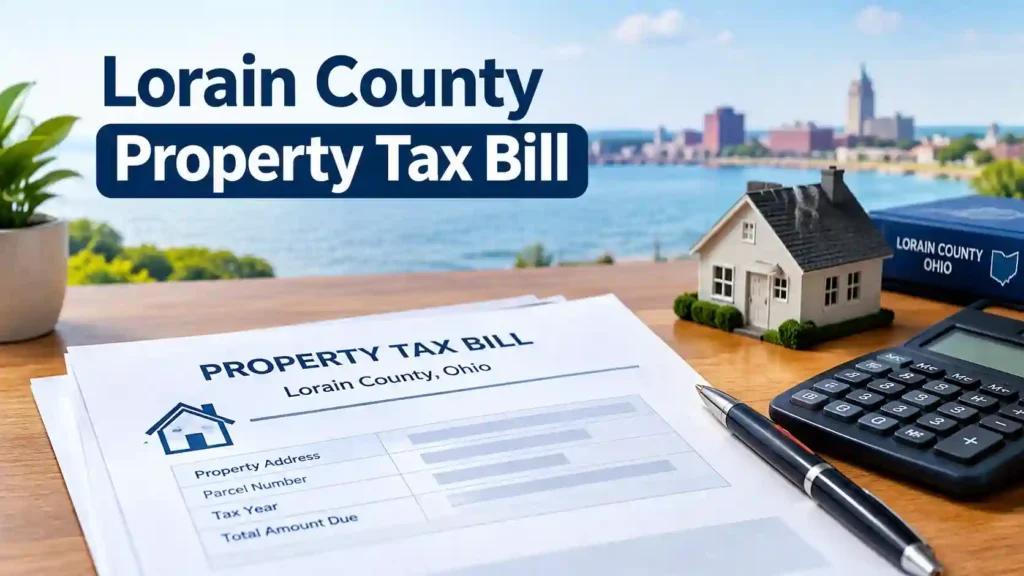
Your Lorain County Auditor property tax bill shows the taxes charged on your property, the local services funded by those taxes, and the amount you may still owe. Understanding the bill helps you check your property details, review tax charges, and confirm that payments have been credited correctly.
The main figures to understand are property value, taxable value, tax rates, levies, total tax, payments credited, and balance due. Each serves a different purpose, so reviewing them in order makes your bill easier to understand.
How to Find Your Lorain County Property Tax Bill
Start with the county’s online property records and tax information. Search for your property using its street address or parcel number, then confirm that the record matches the property you want to review.
Once you locate the correct record, check these details:
- Property address: Confirms the property associated with the bill.
- Parcel number: Identifies the specific property parcel in county records.
- Tax year: Shows the year the tax charge applies to.
- Total tax: Shows the amount charged for the relevant tax period.
- Payments credited: Shows payments recorded against the amount owed.
- Current balance due: Shows the remaining amount outstanding.
The total tax and current balance due may differ if payments or adjustments have been applied. Review both figures to understand the amount originally charged and what remains unpaid.
How to Find the Correct Property
Use the property address if you know it, or search by parcel number when available. A parcel number can help distinguish your property from others with similar addresses.
Before reviewing the tax amount, confirm that the property address and parcel number match your property. If you own multiple properties, check each parcel separately.
What If Your Property Tax Bill Does Not Appear?
If you cannot find your property or bill, try these steps:
- Check the address spelling and format. Try a shorter version if the full address produces no results.
- Search by parcel number if you have it.
- Check the tax year to make sure you are looking for the correct period.
- Confirm that you are using the appropriate county property or tax records. Property valuation information and tax payment records may be available through different services.
- Verify the record with the appropriate county office if the property or bill still does not appear.
A missing search result does not necessarily mean that no taxes are due. Confirm the property record and tax status before making payment decisions.
How to Read Your Lorain County Property Tax Bill
Your property tax bill contains information about the property, its taxable value, applicable tax rates, local levies, assessments, credits, and payments.
Begin with the property address, parcel number, and tax year. Then review the valuation and taxing-district details before checking the total tax and remaining balance.
Property Address and Parcel Number
The property address identifies the location associated with the bill. The parcel number identifies the specific parcel in county property records.
Check both details to confirm that the bill belongs to the correct property. If you own more than one parcel, do not assume that one bill covers all your properties.
Also review the property information shown in the record. If the address, parcel number, or other details appear incorrect, confirm the information before relying on the tax amount.
Tax Year and Billing Period
The tax year identifies the period for which the property taxes are charged. It may differ from the calendar year in which you receive or pay the bill.
For example, 2025 real estate taxes are payable in 2026 in Lorain County. The tax relates to 2025 even though payment takes place in 2026.
When comparing bills or payment records, make sure they relate to the same tax year. Comparing different tax periods can make the amounts appear inconsistent.
Property Value and Taxable Value
Your bill may show both a property value and a taxable value. These figures are related, but market value and taxable value are not the same.
- Market or appraised value: The estimated market value of the property for assessment purposes.
- Taxable value: The value used to calculate property taxes under applicable Ohio rules.
- Credits and exemptions: Eligible benefits may reduce the taxes owed or affect the calculation, depending on the program.
For Ohio real estate, taxable value is generally 35% of the appraised value. This means the taxable value is not the same as the property’s full market value.
To check your valuation, compare the value on your tax bill with the property’s assessment record. If the value appears incorrect, confirm that you are reviewing the correct parcel and tax year before deciding what needs to be addressed.
Tax Rates and Local Taxing Districts
Your property tax bill reflects the tax rates and levies that apply to your taxing district. These charges help fund local services, including schools and other public services.
Two properties with similar values may have different tax bills because they belong to different taxing districts or are subject to different levies and credits.
Tax rates can also change as levies are approved or expire. In addition, a change in property value does not necessarily result in the same percentage change in property taxes. The amount depends on the applicable rates, levies, and other factors.
Levies, Credits, Exemptions, and Adjustments
Levies fund local services and public functions. Depending on your taxing district, your bill may include charges for schools, libraries, parks, public safety, health services, and other local needs.
Credits, exemptions, and adjustments may also affect the amount you owe. Review the bill for:
- Local levies: The taxing authorities or services associated with the charges.
- Credits and exemptions: Any eligible benefits reflected on the bill.
- Adjustments: Entries that affect the amount charged or remaining balance.
- Unexpected charges: Items you do not recognize or cannot explain.
If you expected a credit or exemption but cannot identify it, check the applicable property and tax records. Do not assume that a credit was denied simply because its effect is not immediately clear.
What Do the Abbreviations on Your Property Tax Bill Mean?
Your bill may use abbreviated labels to identify funds, agencies, and public services associated with tax charges.
| Abbreviation | Meaning |
|---|---|
| CO GEN FUND | County General Fund |
| BOND RETIRE | County Bond Retirement |
| MET PARK | Lorain County Metropolitan Park District |
| LCCC | Lorain County Community College |
| 911 | Lorain County 9-1-1 Agency |
| ANTI-DRUG | Lorain County Drug Task Force and Lorain County Crime Lab Unit |
| CJS | Criminal Justice Services for Lorain County Drug Task Force |
| CHILD SERV | Lorain County Children Services |
| LCDD | Lorain County Board of Developmental Disabilities |
| TB CLINIC | Lorain County Tuberculosis Clinic |
| CMMH | Lorain County Board of Mental Health |
These abbreviations identify the fund, agency, or service associated with a charge. An unfamiliar label does not automatically mean that the charge is incorrect.
What Are Current Assessments on Your Property Tax Bill?
Current assessment entries can identify charges associated with a specific property parcel. If a charge appears under “SPECIAL,” the supplied tax-bill reference identifies it as a special assessment on the parcel.
Review the description and amount shown beside the entry to understand which charge appears on your bill. A special assessment should not automatically be treated as part of the property’s assessed value.
If you do not recognize the charge, check the specific entry and confirm what it represents before assuming that it is an error.
What Levies Appear Under HEALTH/MISC?
The HEALTH/MISC section may include levies for health services, fire protection, or ambulance services. Which entries appear depends on the property’s taxing district.
| Taxing district | Levy |
|---|---|
| All districts except 15 and 16 | Lorain County District Health |
| Districts 15 and 16 | Erie County Health District |
| 12, 38, 39, 46, 47, 48, 49, 66, and 67 | Wellington Community Fire |
| 12, 38, 39, 46, 51, 52, 53, 54, 55, 66, and 67 | South Lorain County Ambulance |
| 19, 20, 37, 47, 48, 49, 56, 57, 58, and 60 | Central Lorain County Ambulance |
Your taxing district determines which of these levies may apply. Compare your district number with the list if you see one of these entries on your bill.
Why Is There a City Tax If You Do Not Live in a City?
A charge labeled “CITY” does not necessarily mean that your property is located within a city. In the supplied tax-bill reference, this label may relate to public library levies associated with particular districts.
| Taxing district | Library levy |
|---|---|
| 2, 21, 23, 31, 32, 33, 40, 41, 46, 47, 56, 68, and 70 | Elyria Public Library |
| 3, 24, 48, 58, and 60 | Oberlin Public Library |
Check your taxing district number to see whether one of these library levies matches the entry on your bill. The label should be considered alongside the district and levy information rather than interpreted from your mailing address alone.
Why Is There a Township Tax If You Do Not Live in a Township?
A “TOWNSHIP” label should be read in the context of the taxing district and the specific levy listed on the bill. Your mailing address alone may not explain every tax-bill label.
Check the district number and the name of the charge to identify what appears on your property tax bill. The supplied material does not establish a specific explanation for every township-related entry, so do not assume that the charge is incorrect based on the label alone.
Total Tax, Payments, and Balance Due
The final figures show the amount charged, the payments recorded, and what remains outstanding.
- Total tax: The amount charged for the relevant tax period.
- Payments credited: Payments recorded against the amount owed.
- Current balance due: The remaining amount after recorded payments and applicable adjustments.
The current balance due may be lower than the original tax amount if payments have been credited. It may also differ from an earlier record if the records cover different periods or reflect later adjustments.
Before paying, confirm the tax year, parcel number, total tax, payments credited, and current balance due. If a recent payment is missing or the balance does not match your records, verify the account information before assuming the amount is correct or paying again.
How Is Your Lorain County Property Tax Bill Calculated?
Your Lorain County property tax bill is based on your property’s taxable value, applicable tax rates, and any credits, exemptions, or additional charges. Because tax rates and taxing districts vary, properties with similar values may have different tax bills.
In Ohio, taxable value is generally 35% of a property’s appraised value. Applicable tax rates determine the tax calculated before eligible credits and other adjustments are applied.
For example, if a property has a taxable value of $70,000 and an illustrative tax rate of 50 mills, the calculation would be:
$70,000 × 50 ÷ 1,000 = $3,500
This is a simplified example, not an estimate of an actual Lorain County tax bill. Your final amount depends on the rates that apply to your property, eligible credits and exemptions, special assessments, and other adjustments.
For more information about local rates and how property taxes are distributed, see Lorain County Property Tax Rates.
Why Is Your Lorain County Property Tax Bill Different This Year?
Your Lorain County property tax bill may be higher or lower than last year’s because of changes in property value, local tax levies, state legislation, credits, or other adjustments. The reason depends on your property’s taxing district and the items applied to your account.
For 2026, Ohio House Bill 186 introduced an Inflation Cap Credit intended to limit certain property tax increases. Changes to eligible tax credits, exemptions, and local levies may also affect individual bills. These changes do not affect every property in the same way.
Other common reasons for a different bill include:
- Property value changes: An updated valuation may change the taxable value used to calculate taxes.
- Local tax rates and levies: New, renewed, or expired levies can change the amount charged by applicable taxing districts.
- Credits and exemptions: Changes in eligibility or the credits applied to a property may affect the final amount.
- Special assessments and other charges: New or adjusted charges may appear on the bill.
- Payment differences: Payments, credits, or outstanding balances can change the amount remaining due.
What If Your Property Tax Bill Looks Incorrect?
If your bill looks incorrect, compare it with the previous year’s bill. Check the property details, taxable value, tax rates, credits, additional charges, and payment history to identify what changed.
If the issue concerns property records, valuation, or exemptions, contact the Lorain County Auditor’s Office. For payment credits, the balance due, or payment status, contact the Lorain County Treasurer’s Office.
If you believe your property’s valuation is incorrect, you may be able to challenge it through the applicable review process. A valuation complaint is different from disputing a tax rate or a payment entry.
If you believe your property’s valuation is incorrect, review the Property Value Assessment Process in Lorain County.
Can You Reduce Your Lorain County Property Tax Bill?
Some homeowners may qualify for property tax relief through programs such as the Homestead Exemption or Owner-Occupancy Credit. These programs can reduce eligible property taxes, depending on the homeowner’s circumstances and the applicable requirements.
Not every property owner qualifies, and application requirements may vary. Check the current eligibility rules before assuming a credit or exemption will apply to your bill.
For eligibility details and application requirements, see How to Get Property Tax Relief in Lorain County.
When Is Your Lorain County Property Tax Bill Due?
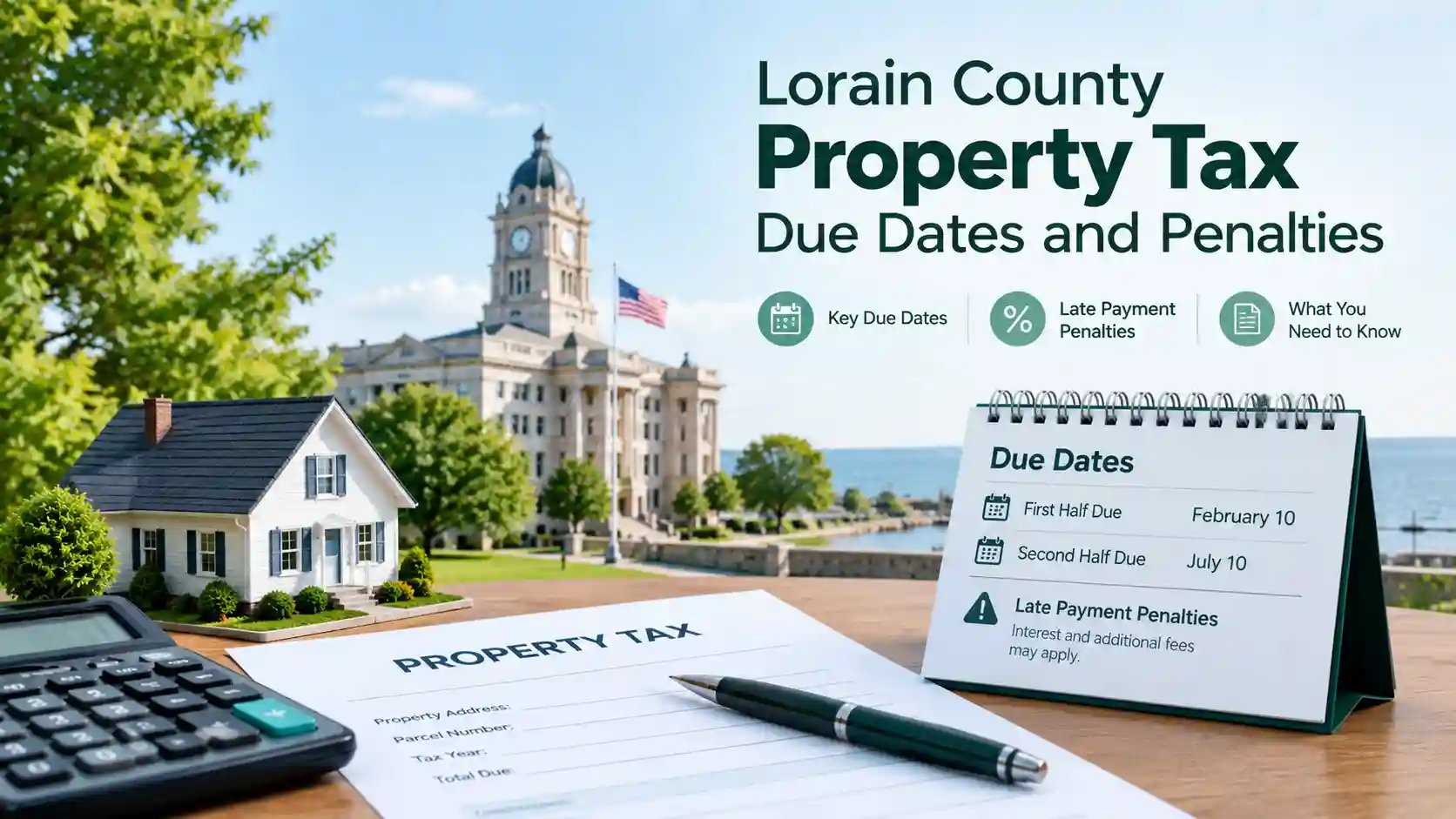
Lorain County property taxes are generally billed in two installments: first-half taxes and second-half taxes. Due dates can change from year to year, so check your current bill and the official Lorain County Treasurer’s website to confirm the applicable deadline.
Late payments may result in penalties or additional charges. Do not rely on a previous year’s due date, particularly if the county has announced a change or extension.
For current deadlines, installment details, and late-payment rules, see Lorain County Property Tax Due Dates and Penalties.
How to Pay Your Lorain County Property Tax Bill
You can look up your property tax bill and access payment instructions through the official Lorain County Treasurer’s website. Before paying, confirm the property details, tax year, installment, amount due, and payment deadline shown on your bill. After submitting payment, save your confirmation and check your account to verify that the payment has been credited.
For detailed payment methods and step-by-step instructions, see How to Pay Property Taxes in Lorain County.
Frequently Asked Questions
Q: What Should I Do If I Do Not Receive My Lorain County Property Tax Bill?
Check your property tax account through the Lorain County Treasurer’s website or contact the Treasurer’s Office to confirm the amount due and payment deadline. Not receiving a bill does not automatically excuse a late payment, so verify your account rather than waiting for another notice.
Q: How Can I Get a Copy of My Lorain County Property Tax Bill?
Visit the Lorain County Treasurer’s website to access property tax information and available online services. If you cannot locate your bill, contact the Treasurer’s Office for assistance.
Q: Do I Still Need to Check My Property Tax Bill If I Have a Mortgage?
Yes. If your mortgage company pays property taxes through an escrow account, confirm that the taxes have been paid and credited to your property account. Contact your mortgage servicer if you are unsure whether the payment has been scheduled or completed.
Q: Can I Pay My Lorain County Property Taxes Monthly Instead of Twice a Year?
The Lorain County Treasurer’s Office offers a Real Estate Tax Prepayment Plan that allows eligible participants to budget for their semiannual property tax bills through monthly payments. Contact the Treasurer’s Office to ask about enrollment, eligibility, and the plan’s requirements.
Q: Why Has My Property Tax Payment Not Appeared on My Account Yet?
A payment may take time to process and for the funds to settle before the credit appears on your account. Keep your payment confirmation and check your account again. If the payment remains uncredited, contact the Treasurer’s Office before making another payment to avoid a possible duplicate.
Q: Can I Pay My Entire Lorain County Property Tax Bill at Once?
Check your current bill and the Treasurer’s payment instructions to confirm the amount outstanding and the available payment options. If you want to pay the full balance rather than separate installments, verify the total due for your account before submitting payment.
Q: What Happens If My Property Tax Bill Is Paid by My Mortgage Company?
If your mortgage company handles property tax payments through escrow, the payment arrangement does not remove your responsibility to confirm that the taxes are paid. Check your property tax account and contact your mortgage servicer if the payment is missing or the balance remains outstanding.
Final Thoughts
Understanding your Lorain County property tax bill helps you verify your property information, recognize the charges, and keep track of what you owe. Review each bill carefully, especially when the amount changes or a payment does not appear as expected.
If something looks incorrect, identify whether it involves property valuation, tax charges, or payment records, then contact the appropriate county office for clarification. Keeping your bill and payment confirmations for your records can also make future reviews and questions easier to resolve.