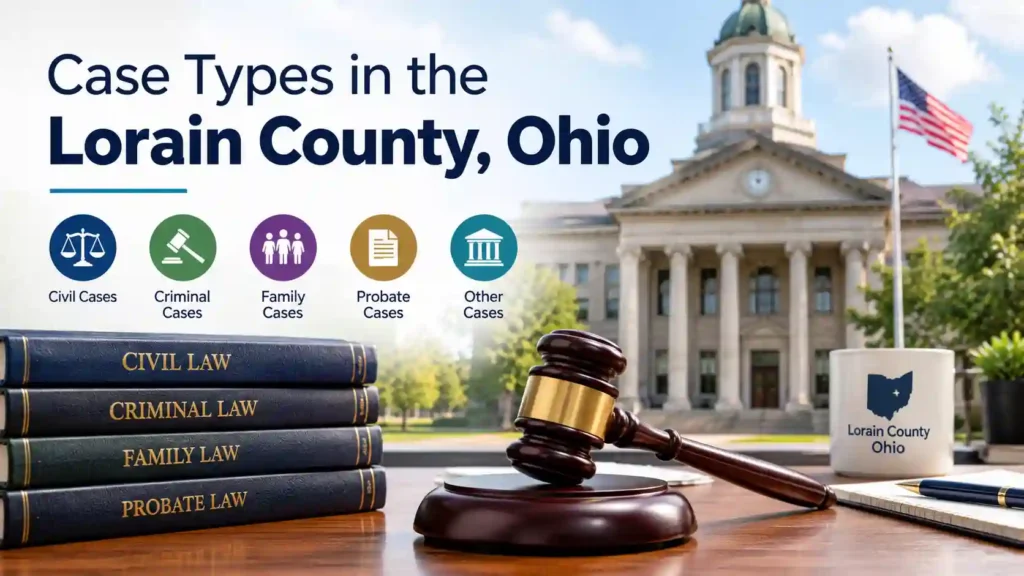
Understanding Case Types in the Lorain County, Ohio courts can help you determine where different legal matters are handled and where to find the information you need. From civil disputes and criminal charges to traffic violations, family matters, juvenile cases, and probate proceedings, each case type follows its own legal process. This guide explains the main types of court cases, which courts handle them, and how to find court records online.
Lorain County, Ohio has a multi-level court system where different courts handle different types of legal matters. The court you go to depends entirely on the type of case you have and the severity of the issue. The main courts in Lorain County are the Court of Common Pleas, the Municipal Courts, the Domestic Relations Court, the Juvenile Court, and the Probate Court.
What Are the Case Types in the Lorain County, Ohio Courts?
Lorain County courts handle a wide range of civil, criminal, family, juvenile, and probate matters. Each court division has its own jurisdiction, meaning it is legally authorized to hear and decide only specific types of cases. Here is a quick overview before we go into detail:
| Case Type | Court That Handles It |
|---|---|
| Civil disputes (over $15,000) | Court of Common Pleas, General Division |
| Criminal felonies | Court of Common Pleas, General Division |
| Civil disputes (under $15,000) | Lorain County Municipal Courts |
| Misdemeanors and traffic cases | Lorain County Municipal Courts |
| Divorce and custody | Court of Common Pleas, Domestic Relations Division |
| Juvenile matters | Court of Common Pleas, Juvenile Division |
| Wills, estates, and guardianships | Court of Common Pleas, Probate Division |
| Appeals | Ohio Ninth District Court of Appeals |
Civil Cases
Civil cases in Lorain County involve legal disputes between individuals, businesses, or organizations where one party seeks money damages or a court order. Unlike criminal cases, civil cases do not result in jail time. The goal is usually to resolve a dispute or get compensation for a loss.
Contract and Money Disputes
Contract disputes are among the most common civil cases in Lorain County. These cases arise when one party claims that another party broke a written or verbal agreement.
Common examples include:
- Unpaid loans or debts
- Breach of business contracts
- Disputes over services not delivered or payment not made
- Personal injury claims seeking financial compensation
If the amount in dispute is more than $15,000, the case is filed in the Court of Common Pleas, General Division. For smaller amounts, the case goes to a Municipal Court.
Property and Landlord-Tenant Disputes
Property disputes and landlord-tenant conflicts are also handled as civil matters in Lorain County. These cases often involve:
- Eviction proceedings (forcible entry and detainer)
- Security deposit disputes
- Property damage claims
- Boundary or easement disagreements between neighbors
- Foreclosure actions
Evictions and small property disputes under $15,000 are typically filed in the Municipal Court. Larger property matters and foreclosures go to the Court of Common Pleas.
Which Court Handles Civil Cases?
The dollar amount and type of civil claim determine which Lorain County court has jurisdiction.
| Claim Amount | Court |
|---|---|
| Over $15,000 | Court of Common Pleas, General Division |
| $15,000 or less | Lorain County Municipal Court |
| Small claims (up to $6,000) | Small Claims Division, Municipal Court |
Note: For small claims cases, you do not need an attorney. The process is simplified and designed for individuals to represent themselves.
Criminal Cases
Criminal cases in Lorain County involve charges brought by the state of Ohio against a person accused of breaking the law. The severity of the offense determines which court handles the case and what penalties may apply.
Felony Cases
Felonies are the most serious criminal offenses in Ohio, carrying potential sentences of more than one year in a state prison. Lorain County felony cases are handled by the Court of Common Pleas, General Division.
Examples of felony charges in Lorain County include:
- Aggravated robbery or burglary
- Drug trafficking or possession of large quantities
- Felonious assault
- Murder or manslaughter
- Grand theft (amounts over $1,000)
- Rape and other serious sex offenses
Felonies in Ohio are classified from F1 (most serious) to F5 (least serious), and the sentence varies based on the level.
Misdemeanor Cases
Misdemeanors are less serious offenses that carry penalties of up to 180 days in jail, a fine, or both. In Lorain County, misdemeanor cases are handled by the Municipal Courts.
Common misdemeanor charges include:
- Petty theft (under $1,000)
- Simple assault
- Disorderly conduct
- Trespassing
- First-offense OVI (Operating a Vehicle Impaired)
- Drug possession (small amounts)
Misdemeanors in Ohio are classified as M1 (most serious) through M4 (minor misdemeanor).
Criminal Charges and Court Proceedings
When a criminal case is filed in Lorain County, it goes through several stages before a final verdict. Understanding these steps helps you know what to expect:
- Arrest and booking – The defendant is taken into custody.
- Initial appearance or arraignment – The charges are formally read, and a plea is entered.
- Preliminary hearing – For felonies, the court determines if enough evidence exists to proceed.
- Pre-trial motions – Both sides may file motions to suppress evidence or dismiss charges.
- Trial or plea agreement – The case is resolved by a judge or jury, or through a negotiated plea.
- Sentencing – If convicted, the judge imposes a sentence.
Pro Tip: If you are facing criminal charges in Lorain County, consulting a licensed Ohio criminal defense attorney as early as possible is strongly recommended.
Traffic Cases
Traffic cases in Lorain County cover everything from minor speeding tickets to serious offenses like driving under the influence. The type and severity of the traffic violation determines how the case is processed and which court handles it.
Traffic Tickets and Moving Violations
Most routine traffic tickets in Lorain County are minor misdemeanors that are handled quickly and typically result in a fine, points on your license, or both. Common minor traffic violations include:
- Speeding
- Running a red light or stop sign
- Failure to yield
- Improper lane change
- Expired registration or license plates
- Seatbelt violations
For most minor tickets, you have the option to pay the fine without appearing in court. However, if you want to contest the ticket, you must appear at the court listed on the citation.
Serious Traffic Offenses
Serious traffic offenses carry heavier penalties and require a mandatory court appearance. These include:
- OVI (Operating a Vehicle Impaired) – Ohio’s term for driving under the influence of alcohol or drugs. A first OVI offense is a first-degree misdemeanor.
- Reckless operation – Driving in a way that endangers persons or property.
- Driving under suspension – Operating a vehicle while your license is suspended.
- Hit-skip – Leaving the scene of an accident without stopping.
- Vehicular homicide or assault – These can be charged as felonies, moving the case to the Court of Common Pleas.
Where Traffic Cases Are Handled
The location and type of traffic offense determines which Lorain County court processes your case.
| Offense Type | Court |
|---|---|
| Minor traffic violations | Lorain County Municipal Court (jurisdiction based on where offense occurred) |
| OVI and serious misdemeanor traffic offenses | Lorain County Municipal Court |
| Vehicular homicide or felony traffic offenses | Court of Common Pleas, General Division |
Important: Lorain County has multiple Municipal Courts, including the Lorain Municipal Court, the Elyria Municipal Court, and the Oberlin Municipal Court. The court that handles your traffic case is usually the one in the municipality where the violation occurred.
Family Law and Domestic Relations Cases
Family law and domestic relations cases in Lorain County are handled exclusively by the Court of Common Pleas, Domestic Relations Division. These cases deal with legal matters that affect families, marriages, and children. Because these cases are often emotionally sensitive, the court focuses on fair outcomes that protect the best interests of all parties, especially children.
Divorce, Dissolution, and Legal Separation
Ohio law provides three ways to end a marriage, and each has different requirements and timelines:
- Divorce – A contested process where spouses disagree on one or more issues such as property division, custody, or support. A judge makes the final decisions.
- Dissolution – An uncontested process where both spouses agree on all terms before filing. It is generally faster and less expensive than a divorce.
- Legal Separation – The spouses remain legally married but live apart under court-ordered terms. This option is chosen for religious, financial, or personal reasons.
All three types are filed with the Lorain County Domestic Relations Court.
Child Custody and Parenting Time
Child custody is one of the most common and most contested issues in Lorain County family law cases. Ohio courts use the term “allocation of parental rights and responsibilities” instead of custody. The two main types are:
- Sole custody – One parent has primary legal and physical responsibility for the child.
- Shared parenting (joint custody) – Both parents share legal decision-making and parenting time based on an approved parenting plan.
The court always decides custody based on the best interests of the child, considering factors like each parent’s involvement, the child’s relationship with each parent, and the stability of each home.
Child Support and Spousal Support
Child support is calculated using Ohio’s standard child support guidelines, which take into account both parents’ incomes, the number of children, and the parenting time arrangement. Support orders are enforced by the Lorain County Child Support Enforcement Agency (CSEA).
Spousal support (formerly called alimony) may also be ordered by the court when there is a significant income difference between spouses. The court considers:
- Length of the marriage
- Each spouse’s earning ability
- Standard of living during the marriage
- Contributions made by each spouse
Domestic Violence Protection Orders
Victims of domestic violence in Lorain County can seek a Civil Protection Order (CPO) through the Domestic Relations Court. A CPO can require the abuser to:
- Stay away from the victim and their home
- Have no contact with the victim or their children
- Move out of a shared residence
- Surrender firearms
Emergency protection orders are available immediately through law enforcement. A full CPO hearing is scheduled within 7 to 10 days of the emergency order being issued.
Important: If you are in immediate danger, call 911. You do not need to wait for a court date to get emergency protection.
Juvenile Cases
Juvenile cases in Lorain County involve legal matters related to minors, which are individuals under the age of 18. These cases are handled by the Court of Common Pleas, Juvenile Division, which operates differently from adult criminal court. The focus in juvenile court is on rehabilitation, family support, and the best interests of the child rather than punishment.
Juvenile Delinquency and Unruly Behavior
A juvenile delinquency case arises when a minor is accused of committing an act that would be a crime if committed by an adult. Examples include theft, assault, vandalism, or drug possession. The court aims to redirect the youth through counseling, community service, probation, or in serious cases, placement in a juvenile detention facility.
Unruly behavior refers to conduct that is not a crime for adults but is a violation for minors, such as:
- Running away from home
- Refusing to obey parents or a guardian
- Being habitually truant from school
- Breaking curfew laws
For unruly cases, the court focuses on family intervention and support services before considering more restrictive options.
Truancy and School Attendance Matters
Ohio law requires all children between the ages of 6 and 18 to attend school, and Lorain County Juvenile Court has jurisdiction over truancy cases. When a child misses school excessively without a valid excuse, the school may refer the matter to the court.
The court may:
- Issue a warning to the family
- Order counseling or intervention services
- Require the child to attend an alternative school program
- Place the child under court supervision
Note: Truancy proceedings focus on getting the child back in school, not on punishing the family.
Abuse, Neglect, and Dependency Cases
When a child in Lorain County is reported to be abused, neglected, or without proper care, the Juvenile Court steps in to protect that child. These cases are often initiated by the Lorain County Children Services (LCCS) after an investigation.
- Abuse – The child has suffered physical, emotional, or sexual harm caused by a parent or caregiver.
- Neglect – The parent or guardian fails to provide basic needs such as food, shelter, clothing, medical care, or education.
- Dependency – The child lacks adequate care due to circumstances beyond the parents’ control, such as a parent’s serious illness or substance abuse.
The court may place the child with a relative, in foster care, or order services to help the family reunify safely.
Juvenile Custody, Paternity, and Related Matters
The Lorain County Juvenile Court also handles custody and paternity matters involving unmarried parents. When parents are not married to each other, paternity (legal fatherhood) must be established before custody or support orders can be made.
Related matters handled in Juvenile Court include:
- Establishing paternity through acknowledgment or DNA testing
- Custody and parenting time orders for children of unmarried parents
- Child support orders when parents were never married
- Modifications to existing custody or support orders
Probate and Estate Cases
Probate and estate matters in Lorain County are handled by the Court of Common Pleas, Probate Division. Probate court deals with the legal process of managing a deceased person’s estate, protecting vulnerable individuals through guardianship, and handling certain personal legal matters like adoptions and name changes.
Wills and Estate Administration
When a person dies in Lorain County, their estate may need to go through the probate process, especially if they owned real estate or significant assets in their name alone. Probate court oversees:
- Validating (proving) the deceased person’s will
- Appointing an executor or administrator to manage the estate
- Paying the deceased person’s debts and taxes
- Distributing remaining assets to heirs or beneficiaries
If a person dies without a will (intestate), the court distributes assets according to Ohio’s intestacy laws, which prioritize spouses, children, and other close relatives.
Note: Not all assets go through probate. Assets with named beneficiaries (like life insurance or retirement accounts) and jointly owned property typically pass directly to the surviving owner or beneficiary without court involvement.
Guardianships
A guardianship is a legal arrangement where the court appoints a person to make decisions for someone who is unable to care for themselves. Lorain County Probate Court handles guardianships for:
- Adults with disabilities or cognitive decline who can no longer manage their personal or financial affairs
- Minors whose parents are deceased, incapacitated, or otherwise unable to care for them
The appointed guardian is responsible for the protected person’s well-being and must report to the court regularly.
Adoption and Legal Name Changes
Adoptions in Lorain County are finalized in Probate Court, unless the adoption involves a child in the foster care system, in which case Juvenile Court handles it. The probate process includes:
- Filing a petition for adoption
- Background checks and home studies
- Terminating the biological parents’ parental rights (if not already done)
- A final hearing where the judge approves the adoption
Legal name changes for adults are also processed through Probate Court. The applicant must file a petition, publish a legal notice, and attend a hearing.
Marriage Licenses and Other Probate Services
The Lorain County Probate Court issues marriage licenses and provides several other administrative services. Additional services include:
- Issuance of marriage licenses to couples planning to marry in Ohio
- Mental health commitment proceedings
- Cognovit notes (civil judgments by confession)
- Trusts administered through the court
Appeals and Reviewing Court Decisions
An appeal is the legal process of asking a higher court to review a decision made by a lower court. Appeals are not new trials. Instead, the appellate court reviews the lower court’s record to determine if a legal error occurred that affected the outcome of the case.
What Is an Appeal?
A party who loses a case in a Lorain County court may have the right to appeal the decision, but only on specific legal grounds. Valid grounds for appeal include:
- The judge made an error in applying the law
- Evidence was improperly admitted or excluded
- The verdict was against the weight of the evidence
- Constitutional rights were violated during the proceedings
Appeals must be filed within specific deadlines. In most civil and criminal cases, the notice of appeal must be filed within 30 days of the final judgment.
Which Court Hears Appeals from Lorain County?
Appeals from Lorain County trial courts go to the Ohio Ninth District Court of Appeals, which is based in Akron, Ohio. This court covers Lorain, Summit, Wayne, and Medina counties.
If a party is not satisfied with the Ninth District’s decision, they may seek further review from the Ohio Supreme Court, though the Supreme Court has discretion over which cases it accepts.
How to Determine Which Lorain County Court Handles Your Case
Finding the right court for your case is a critical first step. Filing in the wrong court can delay your case, result in dismissal, or cause you to miss important deadlines. Follow these steps to identify the correct court:
Identify Your Case Type
Start by clearly identifying what kind of legal matter you are dealing with. Ask yourself:
- Is this a dispute involving money or property?
- Am I facing criminal charges?
- Does this involve my marriage, children, or family?
- Has someone died and left property behind?
- Does this involve a minor?
Your answers will point you toward the right court division. Use the quick-reference table at the top of this guide as a starting point.
Check the Court’s Jurisdiction
Jurisdiction means the legal authority of a court to hear a specific type of case. Two types of jurisdiction matter here:
- Subject matter jurisdiction – Does this court handle this type of case? For example, only the Probate Division handles wills and estates.
- Monetary jurisdiction – For civil cases, the dollar amount in dispute determines whether you go to Municipal Court or the Court of Common Pleas.
If you are unsure, the clerk of court’s office at each courthouse can help you determine if your case belongs there.
Confirm Filing Requirements and Court Location
Once you have identified the correct court, confirm the filing requirements before submitting any documents. Key things to verify include:
- Required forms and documents for your case type
- Filing fees (fees vary by case type and court)
- Deadlines for filing
- Whether you need to serve the other party before or after filing
- The physical address of the courthouse
Lorain County’s major court locations:
| Court | Location |
|---|---|
| Court of Common Pleas (General, Domestic Relations, Juvenile, Probate) | 225 Court Street, Elyria, OH 44035 |
| Lorain Municipal Court | 200 W. Erie Ave, Lorain, OH 44052 |
| Elyria Municipal Court | 328 Broad Street, Elyria, OH 44035 |
| Oberlin Municipal Court | 85 S. Main Street, Oberlin, OH 44074 |
How to Find Lorain County Court Case Records
Lorain County court case records are available to the public, and most can be searched online without visiting the courthouse. Here is how to access them:
To look up case details and docket entries, use Lorain County Court Docket Search.
Search for a Case Online
The fastest way to find a Lorain County court case is through the online case search tools provided by the Ohio courts. You can use:
- Lorain County Clerk of Courts Online Portal – Available at the official Lorain County Clerk of Courts website for Common Pleas cases.
- Ohio Supreme Court’s Case Information Services – For searching appellate and Supreme Court records.
- Municipal Court Websites – Elyria, Lorain, and Oberlin Municipal Courts may have their own online search tools.
Search by Case Number or Party Name
When searching for a case online, you can look it up by case number or by the name of the parties involved.
- Case number search – The most accurate method. The case number is printed on all court documents and notices you receive.
- Party name search – Useful if you do not have the case number. Search using the full legal name of one of the parties. Be aware that common names may return multiple results.
Pro Tip: If searching by name, narrow results by adding the year the case was filed or the case type.
Understand Case Status and Docket Entries
The case docket is the official record of everything that happens in a court case. When you view a case online, you will typically see:
- Case status – Whether the case is open, closed, or pending
- Docket entries – A chronological list of filings, hearings, orders, and other events
- Upcoming hearing dates – Scheduled court appearances
- Judgment information – The outcome if the case has been decided
Reading the docket gives you a complete picture of where the case stands without needing to call the court.
Contact the Clerk of Court
If you cannot find what you need online, contact the Lorain County Clerk of Courts directly. The clerk’s office can:
For more information about the clerk’s office and its services, see our Lorain County Clerk of Courts guide.
- Confirm whether a case exists in their records
- Provide certified copies of court documents (fees apply)
- Accept filings and process case payments
- Answer general questions about court procedures
Lorain County Clerk of Courts contact information:
- Address: 225 Court Street, Elyria, OH 44035
- Phone: (440) 329-5536
- Website: loraincountyohio.gov/clerk
Frequently Asked Questions (FAQs)
Q: What types of cases do Lorain County courts handle?
Lorain County courts handle civil, criminal, traffic, family, juvenile, probate, and estate cases. Each case goes to the court or division with the appropriate jurisdiction.
Q: Which court handles felony cases in Lorain County?
The Court of Common Pleas, General Division, handles felony cases in Lorain County. It is located at 225 Court Street, Elyria.
Q: Where are divorce and child custody cases handled?
Divorce, child custody, dissolution, legal separation, and support matters are handled by the Court of Common Pleas, Domestic Relations Division, at 225 Court Street, Elyria.
Q: Which court handles wills, estates, and guardianships?
The Court of Common Pleas, Probate Division, handles wills, estates, guardianships, adoptions, legal name changes, and marriage licenses.
Q: Where can I look up a Lorain County court case?
Search Common Pleas cases through the Lorain County Clerk of Courts website and municipal cases through the relevant municipal court website. You can search by case number or party name. For assistance, call (440) 329-5536.
Q: Can I file my case at any court in Lorain County?
No. Each court has specific jurisdiction over certain case types and locations. Confirm the correct court with its clerk before filing to avoid delays or dismissal.
Final Thoughts
Understanding the different case types handled by Lorain County courts can help you identify the right court, prepare for the appropriate filing process, and locate relevant case records. Each court has specific jurisdiction, so confirming where your matter belongs is important before submitting documents or relying on an online search.
Use the court’s official resources to verify filing requirements, fees, deadlines, and case information. For legal questions or decisions that could affect your rights, consult a qualified Ohio attorney.