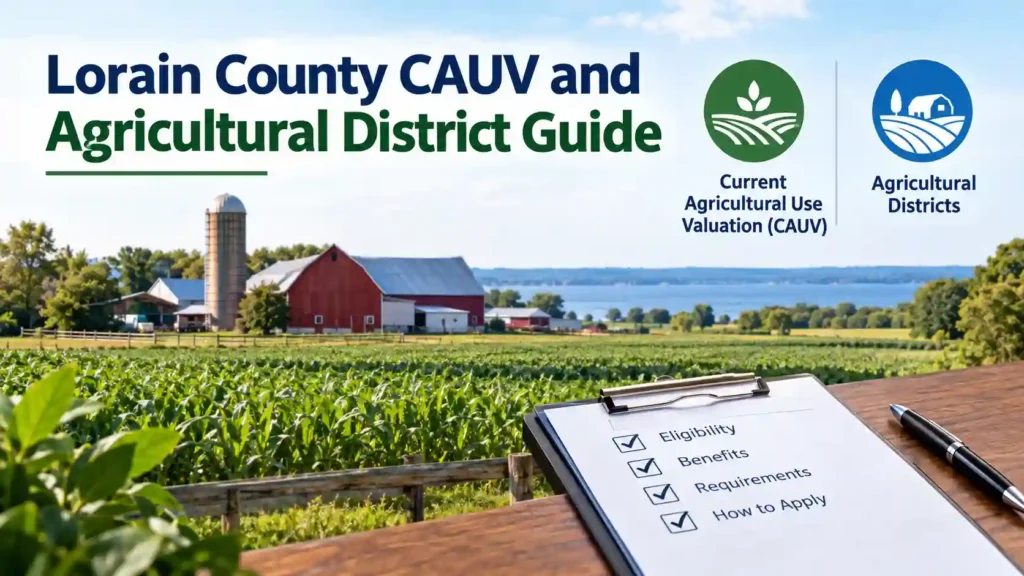
Owning farmland in Lorain County, Ohio, comes with important tax and land-use considerations. The CAUV and Agricultural District programs offer different benefits to eligible landowners, from reduced property tax valuations to legal protections for agricultural land.
However, each program has its own eligibility rules, filing requirements, and deadlines. Understanding these differences can help you choose the right program and maintain your land’s eligibility. For more county property information and assessment resources, visit our Lorain County Auditor homepage.
What Are CAUV and Agricultural District Programs?
CAUV reduces farmland taxes, while Agricultural District status protects eligible agricultural land. This section explains both programs and their key differences.
What Is the CAUV Program in Lorain County?
The Current Agricultural Use Valuation (CAUV) program allows eligible farmland to be assessed according to its agricultural use rather than its potential market value for development. This can reduce the taxable value of qualifying land and lower property tax bills.
To understand how local tax rates affect property tax bills, see Lorain County Property Tax Rates.
The program is administered by the county auditor under Ohio law, while the Ohio Department of Taxation establishes agricultural land values based on factors such as soil types, crop yields, prices, and production costs.
To qualify, land generally must have been devoted exclusively to qualifying commercial agricultural use during the three calendar years preceding the application. Land may qualify if it meets the acreage requirement, satisfies the income requirement for smaller farms, or qualifies under an eligible federal land-retirement or conservation program.
CAUV is a property valuation program, not a property tax exemption. Enrolled land remains subject to property taxes, but its taxable valuation may be lower than its market value.
What Is an Agricultural District in Ohio?
An Agricultural District is a separate program designed to help protect qualifying farmland and agricultural activities. Eligible landowners can apply to place their land in an agricultural district for a five-year period.
Agricultural District status may provide certain legal protections for agricultural activities, including protections related to nuisance claims and special assessments, subject to Ohio law and the circumstances of the property.
Unlike CAUV, Agricultural District enrollment does not automatically reduce a property’s taxable value. The two programs serve different purposes, and eligible landowners may consider applying for both.
CAUV vs. Agricultural District: What Is the Difference?
The main difference is that CAUV focuses on property tax valuation, while Agricultural District status focuses on protecting agricultural land and activities.
| Feature | CAUV Program | Agricultural District |
|---|---|---|
| Main purpose | Reduce taxable land valuation | Provide legal protections for qualifying farmland |
| Tax benefit | May lower property taxes | Does not automatically lower property taxes |
| General land-use requirement | Qualifying agricultural use | Qualifying agricultural production or eligible conservation use |
| Minimum acreage | Generally 10 acres, or less acreage meeting income requirements | Generally 10 acres, or less acreage meeting income requirements |
| Application form | DTE Form 109 | ODA Form 11 |
| Renewal | Annually | Generally every five years |
| Early withdrawal or conversion | May result in recoupment of prior tax savings | Early withdrawal may result in a statutory penalty |
The requirements and benefits differ, so landowners should review the rules for each program before applying.
Who Qualifies for CAUV in Lorain County?
Farmland may qualify for CAUV if it meets Ohio’s agricultural use and acreage or income requirements.
CAUV Eligibility Requirements
Generally, the land must meet one of the following conditions:
- 10 acres or more: The qualifying land must have been devoted exclusively to commercial agricultural use during the required three-year period.
- Less than 10 acres: The qualifying agricultural activity must produce an average yearly gross income of at least $2,500 over the preceding three years, or provide evidence of anticipated income at that level.
- Eligible conservation program: Certain land enrolled in a qualifying federal land-retirement or conservation program may qualify under applicable rules.
The county auditor may require information about the land’s use, acreage, agricultural production, income, and any qualifying conservation agreements.
What Agricultural Activities May Qualify?
Qualifying activities may include commercial crop production, livestock operations, and other agricultural uses recognized under Ohio law. Certain qualifying woodland and conservation areas may also be included when the applicable requirements are met.
Not every rural property automatically qualifies. The land must meet the program’s specific use requirements, and nonagricultural portions of a property may not qualify simply because they share the same parcel.
Who Qualifies for Agricultural District Status?
An owner of land used for agricultural production may apply to place eligible land in an Agricultural District.
Agricultural District Eligibility Requirements
Generally, the land must meet these requirements:
- Three years of qualifying use: The land must have been used exclusively for agricultural production, or qualify under an eligible federal conservation or land-retirement program, during the three consecutive calendar years before the application.
- 10 acres or more: The land generally must meet the minimum acreage requirement.
- Less than 10 acres: The owner must provide evidence of an average annual gross income of at least $2,500 during the preceding three years, or evidence that the land is expected to produce that amount.
Evidence may include information about crops, acreage, livestock, expected yields, market prices, and agricultural income.
Additional requirements may apply to woodland and mixed-use properties. Landowners should confirm eligibility with the Lorain County Auditor before submitting an application.
To check parcel details and property information, use our Lorain County Property Search tool.
Where to Find CAUV Forms and Agricultural District Applications
The Lorain County Auditor provides the forms used to apply for CAUV and Agricultural District status.
For step-by-step instructions and helpful resources, explore our Lorain County Auditor Forms & Guides page.
The main forms include:
- DTE Form 109: Initial application for Current Agricultural Use Valuation.
- DTE Form 109A: Annual CAUV renewal application.
- ODA Form 11: Application for placement of farmland in an Agricultural District.
- CAUV Gross Income Worksheet: Supporting information for properties that must meet the income requirement.
- CAUV Guidelines: Information about qualifying land uses and program requirements.
Depending on the property and its agricultural activities, you may also need supporting documents, such as income records, crop information, maps, or conservation program agreements.
For questions about eligibility, forms, or filing requirements, contact the Lorain County Auditor’s Office at 440-329-5485.
How to Apply for CAUV in Lorain County
Landowners must submit the initial CAUV application to the Lorain County Auditor and demonstrate that their property meets the program requirements.
Step 1: Gather Property, Agricultural Use, and Income Records
Before completing the application, gather your parcel information, acreage details, and records showing how the land has been used for agriculture.
If the qualifying agricultural acreage is less than 10 acres, prepare evidence of the required agricultural income or anticipated income. If the property qualifies through a federal conservation program, supporting documentation may be required.
Step 2: Complete the Initial CAUV Application
Complete DTE Form 109, the initial application for Current Agricultural Use Valuation. Provide accurate ownership details, parcel numbers, acreage, and information about agricultural use.
Review the form carefully and include any supporting documents required for your situation.
Step 3: Pay the Required Application Fee
The initial CAUV application requires a one-time, nonrefundable fee of $25.
Make sure the application and required fee are submitted according to the auditor’s instructions.
Step 4: Submit the Application to the Auditor
File the completed application with the Lorain County Auditor’s Office. The application must be received within the filing period, so do not rely solely on the date you mail it.
Keep a copy of your application and supporting records for your files.
Step 5: Meet the Filing Deadline
The initial CAUV application must generally be filed after the first Monday in January and before the first Monday in March.
Because the deadline is based on specific weekdays rather than a fixed calendar date, confirm the applicable filing dates for the tax year with the auditor.
How to Enroll Land in an Agricultural District
Landowners can apply for Agricultural District status by submitting ODA Form 11 to the county auditor.
Step 1: Review the Eligibility Requirements
Confirm that your property meets the agricultural use, acreage, and income requirements. Gather records showing the property’s qualifying use during the required period.
Step 2: Complete ODA Form 11
Fill out the Application for Placement of Farmland in an Agricultural District. Include the requested ownership, parcel, acreage, and agricultural use information.
Attach supporting evidence where required.
Step 3: Submit the Application
File the completed form with the Lorain County Auditor’s Office.
If the land is within a municipal corporation, or an applicable annexation petition includes the property, a copy may also need to be filed with the clerk of the municipality’s legislative body. Additional review and a public hearing may be required.
Step 4: Confirm the Application Status
Follow up with the auditor’s office if you need to confirm receipt or learn whether additional information is required.
Agricultural District enrollment generally lasts five years. Owners who want to continue participation must follow the applicable renewal requirements.
How to Renew CAUV and Maintain Eligibility
CAUV must be renewed annually. Missing the renewal deadline or failing to meet the program requirements may result in removal from the program and additional tax charges.
Annual CAUV Renewal
Complete DTE Form 109A and file it with the Lorain County Auditor before the first Monday in March. The auditor’s office generally mails annual renewal forms by January 15.
Review the form carefully and report the current agricultural use of the property. If the land’s use has changed, provide the requested explanation and supporting documentation.
Income Requirements for Smaller Properties
If the qualifying agricultural acreage is less than 10 acres, the owner generally must demonstrate an average yearly gross income of at least $2,500 from qualifying agricultural activity over the preceding three years, or provide evidence of anticipated income at that level.
According to the county’s renewal guidance, rental payments for land are not counted as qualifying agricultural product income. Check the current application instructions to determine what evidence is acceptable.
Ownership Changes
A new owner generally must file an initial CAUV application, DTE Form 109, even if the previous owner participated in the program. The initial application fee also applies.
Do not assume that CAUV participation will continue automatically after a property transfer. Contact the auditor to confirm the requirements for the transferred land.
Maintain Accurate Records
Keep records of agricultural activities, crop production, income, acreage, woodland management, and conservation agreements. Update your information when ownership or land use changes.
Tips for Managing CAUV and Agricultural District Participation
A few practical steps can help landowners maintain eligibility and avoid unnecessary penalties.
- Track filing deadlines: Mark the annual CAUV renewal deadline and any Agricultural District renewal dates on your calendar.
- Keep agricultural records: Save income records, crop details, livestock information, and documents showing how the land is used.
- Review parcel ownership: Make sure applications accurately reflect the legal owner and the relevant parcel numbers.
- Check woodland requirements: Properties with woodland may need to meet additional conditions or provide a woodland management plan, depending on the type and size of the wooded area.
- Report changes in land use: Construction, development, or other changes may affect the property’s eligibility.
- Understand each program separately: CAUV and Agricultural District status have different purposes, requirements, and consequences for withdrawal.
When in doubt, contact the Lorain County Auditor before changing the use of enrolled land or missing a filing deadline.
Common CAUV and Agricultural District Application Problems
Applications may be delayed, rejected, or affected by eligibility issues when important information is missing or incorrect.
Incomplete Applications
Missing parcel numbers, ownership details, acreage figures, signatures, or supporting records can create problems. Review every section before submitting the form.
Missing Income Evidence
Properties with less than 10 qualifying acres may need documentation showing the required agricultural income or anticipated income. Prepare the relevant information before filing.
Missed Filing Deadlines
CAUV applications and annual renewals have specific filing windows. Late or incomplete submissions can put the property’s participation at risk.
Incorrect Ownership Information
Ownership changes may require a new CAUV application. Verify the current legal ownership and parcel details before filing.
Confusing the Two Programs
CAUV and Agricultural District status are not interchangeable. Applying for one does not automatically enroll land in the other.
Missing Woodland or Conservation Documents
Certain woodland uses and federal conservation arrangements require additional information, maps, contracts, or management documentation. Check the applicable form instructions.
Missing Municipal Filing Requirements
Agricultural District applications involving land within a municipal corporation or an applicable annexation petition may require an additional filing with the municipality. Confirm whether this applies to your property.
What Happens if Land Loses CAUV Eligibility?
Land that no longer qualifies for CAUV may be subject to a recoupment charge based on the tax savings from the preceding three years. The charge may apply when enrolled land is converted to a nonqualifying use or otherwise ceases to meet the program requirements.
CAUV Recoupment
Under Ohio law, converting CAUV land to a nonqualifying use can trigger a charge equal to the tax savings on the affected land during the three years immediately preceding the year of conversion.
The charge is based on the affected land and its applicable tax savings. Landowners should check with the auditor before making changes that could affect eligibility.
Missed or Incomplete Renewal Applications
Failure to submit a required renewal application on time may result in removal from CAUV and an increase in the property’s taxable valuation. A penalty may also apply under the relevant rules.
Owners should contact the auditor promptly if they discover a missed deadline or an application issue.
Conservation Land Requirements
Special rules can apply to land valued under qualifying conservation provisions. If such land stops meeting the applicable requirements within the relevant period, additional recoupment may apply.
Agricultural District Withdrawal
Agricultural District status has separate withdrawal rules. Removing land before the end of the five-year enrollment period may result in a penalty under Ohio law, depending on the circumstances.
Before withdrawing from either program or changing agricultural land use, contact the Lorain County Auditor to understand the potential financial and legal consequences.
Frequently Asked Questions
Q: Does CAUV lower property taxes in Lorain County?
Yes. CAUV can lower property taxes by valuing qualifying farmland according to its agricultural use instead of its development potential. It does not eliminate property taxes entirely.
Q: How many acres are needed to qualify for CAUV?
Generally, a property must have at least 10 acres devoted to qualifying agricultural use. Properties with less than 10 acres may qualify if they meet the required agricultural income or anticipated income test, or another applicable qualifying provision.
Q: What is the minimum income requirement for a smaller farm?
Qualifying agricultural land with less than 10 acres generally must produce an average yearly gross income of at least $2,500 over the preceding three years, or provide evidence of anticipated income at that level.
Q: When is the CAUV application deadline?
The initial application and annual renewal generally must be filed after the first Monday in January and before the first Monday in March. Confirm the applicable deadline with the Lorain County Auditor.
Q: Does CAUV renew automatically?
No. Landowners must file a CAUV renewal application every year. The renewal form is DTE Form 109A.
Q: How long does Agricultural District status last?
Agricultural District enrollment generally lasts five years. Owners who want to continue participation must follow the applicable renewal process.
Q: Can a property qualify for both CAUV and Agricultural District status?
Yes, if it independently meets the requirements of both programs. CAUV addresses property valuation, while Agricultural District status provides certain protections for qualifying agricultural land and activities.
Q: What happens if I sell property enrolled in CAUV?
A new owner generally must submit an initial CAUV application, DTE Form 109, even if the previous owner was enrolled. Contact the auditor to confirm the filing requirements and applicable deadlines.
Q: Where can I get CAUV and Agricultural District forms?
Forms are available on the Lorain County Auditor’s official Forms page. The page includes DTE Form 109, DTE Form 109A, ODA Form 11, and additional CAUV resources. For further assistance, contact the Lorain County Auditor’s Office at 440-329-5485.
Final Thoughts
Understanding the difference between CAUV and Agricultural District status can help Lorain County farmland owners make informed decisions about property taxes and agricultural land protections. CAUV may reduce the taxable valuation of qualifying farmland, while Agricultural District enrollment provides separate legal protections.
Both programs have specific eligibility rules, filing deadlines, and ongoing requirements. Keep accurate agricultural records, submit applications and renewals on time, and contact the Lorain County Auditor before changing land use or withdrawing from either program. This can help you maintain eligibility and avoid unexpected penalties.