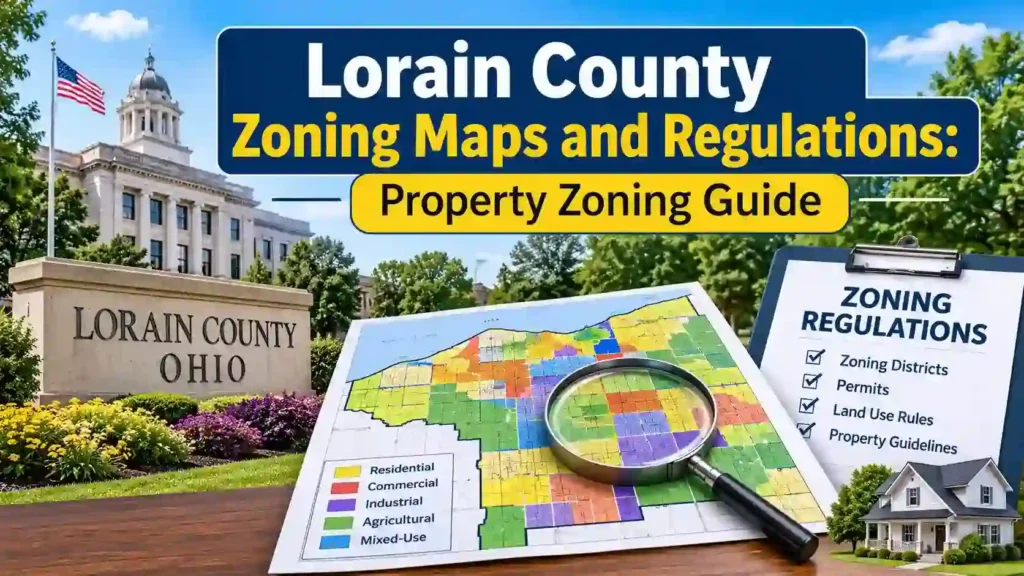
Every parcel in Lorain County, Ohio falls under a specific zoning district that controls what you can build and how you can use the land. The county’s online GIS tools let you check a property’s zoning in minutes, while individual cities, villages, and townships enforce their own local codes within county boundaries.
This guide shows you where to find official zoning maps, how to read them, what the main zoning districts allow, and how to apply for permits, variances, or rezoning. Explore more property guides on our Lorain County Auditor page.
Where to Find the Lorain County Zoning Map
Official zoning maps are available through the Lorain County Auditor’s GIS website and through each local jurisdiction’s own planning office. Because Lorain County contains dozens of separate cities, villages, and townships, zoning authority is split between the county and these local governments.
Lorain County Interactive Zoning Map
Access the county’s interactive zoning layer through the Lorain County Auditor’s GIS Parcel Viewer or GIS Portal, available at loraincountyauditor.gov. These tools overlay zoning boundaries on an aerial map of the county and are maintained by the Auditor’s GIS Department.
Pro tip: If you spot an error on the GIS zoning layer, report it directly to the Auditor’s GIS Department at 440-329-5272 or auditor@lcauditor.com, since the county relies on local jurisdictions to keep this data current.
- How to access it: Open the Parcel Viewer or GIS Portal from the Auditor’s website and search by address or parcel number.
- What it displays: Parcel boundaries, zoning designation layers, jurisdiction boundaries, aerial imagery, and flood zone data.
- Identifying designations: Click on a parcel to view its zoning code and the township, city, or village that governs it, since the county map pulls data directly from local zoning authorities.
City, Township, and Village Zoning Maps
Most cities, villages, and townships in Lorain County publish their own zoning maps because they, not the county, enforce zoning within their borders. The City of Lorain, City of Elyria, and other municipalities maintain separate planning departments and zoning codes.
- Finding local maps: Visit the planning or building department page on your city, village, or township website.
- County vs. local maps: The county’s GIS map is a reference tool showing parcel-level zoning data compiled from local sources, while the local map is the legally binding document.
- Official PDF maps: Many jurisdictions, such as townships, post adopted zoning maps as downloadable PDFs on their municipal websites.
How to Check the Zoning of a Property in Lorain County
To find a property’s zoning classification, search the parcel on the Lorain County GIS map and then confirm the designation with the local zoning office. This two-step approach ensures accuracy, since GIS data can lag behind recent zoning changes.
Steps to Look Up Property Zoning
- Find the property address or parcel number. Check a tax bill, deed, or the Auditor’s property search tool if you do not already know it.
- Open the Lorain County GIS zoning map. Go to the Auditor’s GIS Parcel Viewer or GIS Portal.
- Locate the property on the map. Enter the address or parcel number into the search field.
- Identify its zoning designation. Click the parcel to view the zoning code assigned to it.
- Contact the local zoning department to verify. Call the city, village, or township office to confirm the classification is current before making decisions based on it.
How to Find Your Property’s Zoning District
- Searching by address or parcel number: Both search methods work on the county’s GIS portal and most local map tools.
- Understanding labels and colors: Zoning maps use color coding and abbreviated codes, such as R-1 for single-family residential or B-2 for general commercial in the City of Lorain’s zoning code, with a legend explaining each category.
- Verifying with local authorities: GIS maps serve as reference tools and are not a substitute for an official zoning certificate from the local zoning administrator.
What Are the Different Zoning Districts in Lorain County?
Zoning districts fall into five broad categories: residential, commercial, industrial, agricultural, and mixed-use or special purpose. Exact district names and permitted uses vary by jurisdiction, but these categories appear in most local zoning codes across the county.
Residential Zoning Districts
- Single-family residential: Permits one home per lot, typically with minimum lot size and setback requirements.
- Multi-family residential: Allows duplexes, apartments, or condominiums depending on the specific district.
- Manufactured home residential: Designated for manufactured or mobile home placement, often within approved parks or subdivisions.
Commercial Zoning Districts
- Neighborhood commercial: Smaller-scale retail and service businesses meant to serve nearby residents.
- General commercial: Broader range of retail, office, and service uses, often along major corridors.
- Downtown commercial: Applies to historic downtown districts with mixed retail, dining, and office space.
- Business and retail uses: Covers standalone stores, shopping centers, and professional offices depending on the district.
Industrial Zoning Districts
- Light industrial: Permits warehousing, light assembly, and similar low-impact operations.
- Heavy industrial: Allows manufacturing, processing, and operations with greater noise, traffic, or environmental impact.
- Manufacturing and industrial activities: Subject to additional performance standards covering noise, emissions, and buffering from residential areas.
Agricultural and Rural Zoning
- Agricultural land uses: Protects farmland and permits crop production, livestock, and related operations.
- Farm-related activities: Includes accessory structures such as barns, silos, and farm stands.
- Rural residential development: Often allows single-family homes on larger lots alongside agricultural uses.
Mixed-Use and Special Purpose Zoning
- Mixed-use development: Combines residential, commercial, and sometimes office uses within a single district or building.
- Planned Unit Development (PUD): Allows flexible, master-planned development that may not fit standard district rules.
- Open space and recreational areas: Preserves parks, green space, and public recreation land.
- Special zoning overlays: Adds extra requirements on top of a base district, such as historic preservation or floodplain standards.
Lorain County Zoning Regulations and Land Use Restrictions
Zoning regulations control what you can build, where you can build it, and how the finished structure can be used. These rules protect property values and ensure compatible development within each district.
Permitted and Conditional Land Uses
- Uses permitted by right: Allowed automatically within a district without special approval.
- Conditional or special uses: Require a separate application and public hearing before approval, since they may affect neighboring properties.
- Prohibited land uses: Not allowed anywhere within that zoning district under any circumstances.
Building Setbacks, Lot Sizes, and Property Dimensions
- Front, side, and rear setbacks: Minimum distances a structure must sit from property lines, which vary by district and lot type.
- Minimum lot area and width: Sets the smallest buildable lot size allowed in a given district.
- Building height restrictions: Limits how tall a structure can be, often measured in feet or number of stories.
- Lot coverage requirements: Caps the percentage of a lot that buildings and impervious surfaces can occupy.
Residential and Commercial Development Rules
- Home construction and additions: Must comply with setback, height, and lot coverage rules for the district.
For information about construction approvals and permit requirements, see How to Obtain Building Permits in Lorain County, Ohio. - Commercial buildings and business operations: Subject to use restrictions, signage rules, and operating standards specific to commercial districts.
- Parking and access requirements: Minimum parking space counts and driveway access standards apply to most new development.
- Landscaping and site development: Buffer planting, screening, and stormwater management requirements often apply to larger projects.
Agricultural and Vacant Land Restrictions
- Farming and agricultural activities: Generally protected under agricultural zoning, though some operations may still require local approval.
- Residential construction on rural parcels: May require minimum acreage or frontage before a home can be built.
- Restrictions on undeveloped land: Vacant parcels remain subject to the same zoning rules as developed ones, so any future use must comply with the applicable district.
If you are searching for available properties, see How to Find Vacant Land or Foreclosed Properties in Lorain County.
How to Get Zoning Permits in Lorain County
You generally need zoning approval before starting construction, adding a structure, or changing how a property is used. The specific permit depends on the scope of the project and the jurisdiction where the property sits.
When Is a Zoning Permit Required?
- New construction: Any new building typically requires zoning review before a building permit is issued.
- Home additions and accessory structures: Additions, garages, sheds, and similar structures usually need zoning approval.
- Commercial property development: New commercial buildings or site improvements require zoning compliance review.
- Changes in property use: Converting a property to a different use than its current zoning classification allows requires approval first.
Zoning Permit Application Process
- Identify the property’s zoning jurisdiction. Confirm whether the county or a specific city, village, or township handles zoning there.
- Review the applicable zoning regulations. Check the district’s permitted uses, setbacks, and other standards.
- Contact the zoning office. Reach out to the correct local zoning administrator with questions before applying.
- Complete the required application. Fill out the zoning permit form provided by the jurisdiction.
- Submit plans and supporting documents. Include site plans, surveys, or other materials the office requires.
- Wait for zoning review and approval. Processing times vary by jurisdiction and project complexity.
Common Zoning Applications and Approvals
- Zoning certificates and permits: Confirm a proposed use or structure complies with current zoning before construction begins.
- Conditional use permits: Required for uses that need extra review due to their potential impact on neighboring properties.
- Variance applications: Requested when a property cannot meet a specific zoning standard, such as a setback requirement.
- Property rezoning applications: Filed when an owner wants to change a parcel’s zoning classification entirely.
How to Request a Zoning Change or Variance
If your intended use does not comply with current zoning, you can apply for a variance or request a formal rezoning, depending on whether you need an exception to one standard or a different zoning classification altogether.
How to Apply for a Zoning Change
- Understanding reclassification: A rezoning changes the zoning district assigned to a parcel, which can open up new permitted uses.
- Submitting a request: File a rezoning application with the local planning or zoning office, usually with supporting documentation.
- Public hearings and approval: Rezoning typically requires review by the Planning Commission and a vote by the local legislative body, with public notice and a hearing.
How to Request a Zoning Variance
- What qualifies for a variance: Variances are granted when strict application of a zoning rule creates a practical difficulty unique to the property.
- Required documents: Applications usually require a site plan, a written explanation of the hardship, and an application fee.
- Zoning Board of Appeals review: The local Board of Zoning Appeals reviews variance requests at a public hearing before deciding.
Lorain County Planning and Zoning Department: Contact and Services
Zoning authority in Lorain County is divided between the county’s Community Development Department and each city, village, or township’s own zoning office. Knowing which office to contact saves time and avoids delays.
Lorain County Community Development Department
The Lorain County Community Development Department oversees planning and zoning in unincorporated townships that have not adopted their own zoning regulations. The Lorain County Planning Commission also reviews subdivision plats and provides planning guidance.
For example, the City of Lorain handles its own zoning through its Building, Housing & Planning Department, which reviews zoning permits and variance applications under the city’s zoning code.
Contact Local City and Township Zoning Offices
Incorporated cities, villages, and many townships in Lorain County administer their own zoning codes and maintain their own zoning administrators. Always confirm current regulations directly with the office that governs your property, since local codes can differ significantly from one jurisdiction to the next.
Lorain County Community Development Department
Address: 226 Middle Avenue, Room 400, Elyria, OH 44035
Phone: (440) 328-2323
Fax: (440) 328-2349
Frequently Asked Questions (FAQs)
Q: Does Lorain County Have an Online Zoning Map?
Yes. The Lorain County Auditor’s GIS Parcel Viewer and GIS Portal display zoning layers alongside parcel boundaries and aerial imagery. Both tools are free to use.
Q: How Can I Find the Zoning of My Property in Lorain County?
Search your address or parcel number on the Lorain County GIS zoning map, then confirm the designation with your local zoning office.
Q: Are Zoning Regulations the Same Across Lorain County?
No. Zoning regulations vary by jurisdiction because cities, villages, and townships generally enforce their own zoning codes.
Q: Can I Build a House on Agricultural Land in Lorain County?
In many cases, yes. However, eligibility depends on the agricultural district’s minimum lot size and frontage requirements. Confirm the rules with your local zoning office before planning construction.
Q: How Do I Find Out What I Can Build on My Property?
Find your property’s zoning district through the county GIS map, then review its permitted uses and dimensional standards with the local zoning administrator.
Q: Where Can I Get a Copy of My Property’s Zoning Map?
View or download a zoning map from your city, village, or township planning department’s website, or use the Lorain County Auditor’s GIS tools for a parcel-level reference.
Q: How Can I Request a Zoning Variance in Lorain County?
Submit a variance application with supporting documents to your local zoning office. The office will schedule a public hearing before the Board of Zoning Appeals.
Q: Who Should I Contact About Zoning Restrictions?
Contact the zoning administrator for your city, village, or township. For unincorporated areas without their own zoning code, contact the Lorain County Community Development Department.
Final Thoughts
Understanding Lorain County zoning rules before purchasing land or starting a project can help you avoid restrictions that affect how a property may be used or developed. The most important step is confirming the zoning classification and applicable regulations with the local authority responsible for your property.
GIS maps provide a useful starting point, but verify permitted uses, setbacks, and approval requirements directly with the zoning office. Taking these steps early can help prevent application delays, unexpected costs, and problems with future development plans.